Showing posts with label film. Show all posts

Tuesday, February 18, 2020

MEDIA DIARY ~ FILMS, FEB 19, 2020

Yes, I know, it's been a while, so please excuse me if I just dive into this process head-first, without much in the way of explication or lubrication first. Suffice it to say that I've been having RIDICULOUS problems with blogger's AdSense functionality (haven't made a penny in two months, despite my blogs being over-run with an obnoxious amount of ads) and so my motivation hasn't been what it could be. Then I figured, I mostly use this blog as a way to keep track of what I've watched, read, and seen, so why not just keep blogging until the situation sorts itself out? So I guess that's what I'm going to try to do. Cheers! - Jerky

UPGRADE (2018) ~ The sci-fi noir revenge thriller Upgrade is a must-see for fans of all those genres, and definitely belongs on any list of the best SF films to be released so far this millennium. It ranks alongside Ex Machina and Dredd and Her. Fun, dark, ultraviolent, original, and surprising!


THE DEATH OF STALIN (2017) ~ Speaking of pitch-black satire, the latest film by Armando Iannucci—one of the key figures in the Britcom Renaissance and frequent partner of bona fide geniuses Chris Morris and Steve Coogan—The Death of Stalin presents a highly fictionalized account of the panic, turmoil and terror that gripped the Central Committee and other important elements of the Soviet government in the wake of Joseph Stalin's sudden death in 1953. Uniformly fantastic performances (Michael Palin, Steve Buscemi, Simon Beale, Andrea Riseborough and Jeffrey Tambor are all perfect) and help to elevate this film from high minded farce into something approaching (but not quite attaining) the level of a Dr Strangelove. Based on a French graphic novel, The Death of Stalin was banned in Russia, Belarus, Kazakhstan and Kyrgyzstan.


APOSTLE (2018) ~ An excellent addition to the Folk Horror canon, of which the prime exemplar is the (original) Wicker Man, which also happens to be a heavy influence on this film. It's been a good couple years for this genre-within-a-genre, starting with The Witch and hitting definite peaks with The Ritual, A Dark Song, and now Apostle. Although not as rooted in actual philosophies, beliefs and ritual practices as some of the best in occult cinema, Apostle does a good job of presenting what life must have been life in some of those far flung turn of the century religious communes, some of which you can still find in the darker parts of both North America and the Old World. As a horror film in the Western tradition, I consider it one of the best of the year so far... richly envisioned, convincingly acted, beautifully designed, and both thrilling and intriguing. Some might find it a bit long, somewhat confusing, and more gruesome than necessary. Horror fans should definitely see it and, if they like it, help to spread the word, because one takes from a work of art only that which one is capable of taking, and a lot of dummies are putting up bad reviews that sound a whole lot like the cracking of piggish teeth on the pearls cast before them.


POSSUM (2028) ~ Brilliant debut feature from Matt Holness, creator of the cult horror comedy TV satire Garth Merenghi's Darkplace. This film puts Sean Harris' uniquely disturbing and expressive looks to maximum use, kind of in the same way that David Cronenberg did with Christopher Walken in The Dead Zone. Possum features an ambiance redolent with dread and anxiety, and you can feel the pressure of sanity at its breaking point throughout, like the internal pressure inside a bottle forever pushing away at the cork stopping it up. Another Cronenberg film this reminded me of is the under-rated, underseen Spider. And also The Babadook, only with a far creepier imaginary baddie in the form of Possum. Just excellent.


HAGAZUSSA (2017) ~ The disturbing story of Albrun, a lonely goat-herding girl who lives with her mother in a secluded shack in the German Alps in the 15th century. People in the nearby village are cruel to Albrun and her mother both, apparently believing them to be witches. When Albrun’s mother falls ill—leading to some disturbing scenes in which you’ll start to think that maybe the villagers have the right idea—sexually assaults her, then dies. Cut to 15 years later. Albrun, still living in the shack and tending her goats, has a baby boy. A town priest gives her the gift of her mother’s polished skull, which Albrun takes home and uses as part of a memorial shrine. Another villager, Swinda, befriends Albrun, but we soon find out that her intentions are anything but good. Deception leads to Albrun once again being raped. She takes revenge on the village in a particularly gruesome way, then eats a magic mushroom that causes her to indulge in some strange cruelties and engaging in a number of taboos, ultimately leading to her apparently supernatural demise. A truly great folk horror film.


THE LIGHTHOUSE (2019) ~ A fantastic performance by Willem Dafoe and a decent one by Robert Patinson anchor director Robert Eggers’ black-and-white, Lovecraft-tinged follow-up to his magnificent The VVitch (2015), but for me, The Lighthouse ends up feeling like something less than the sum of its (admittedly superlative) parts. For instance, the conversations, though thoughtfully articulated and grandly performed, don’t ever really seem to go anywhere. And the hallucinatory elements, featuring mermaids and tentacles and angry sea-birds, felt detached from the narrative. I did like the way it ended, however. I’ll probably have to give this one another watch before I make up my mind about it.


ANIARA (2018) ~ A beautiful, poetic, philosophical science fiction film from Sweden in which a huge colony craft (the titular Aniara) carrying thousands of immigrants from a Sun-ravaged Earth to Mars gets knocked off course and has to dump all its fuel, leaving it unable to turn around until it encounters a celestial body that it can use as a gravity well to turn around, turning a planned month-long trip into what the captain informs his passengers will now be a minimum two year drift through empty space. Unfortunately, he’s lying. The truth of the matter is that the chances of encountering a celestial body at all are pretty much nil, and as more and more people cotton on to this fact, the more the passengers’ morale—not to mention the state of the craft—deteriorates. There’s a sub-plot about a hallucination machine that breaks down—or rather, has the AI equivalent of a mental breakdown—leaving the passengers without any means of escaping from the soul-crushing reality of their predicament, causing cults to rise up and suicides to skyrocket. Time passes. The main character we’re following does her best to stay positive, despite suffering some profoundly unjust situations and tragic losses. She finds love. Starts a family. More time passes. Entropy sets in. Things get dark. Then things get REALLY dark. Then more time passes. Before you know it, five million years have gone by and you’re asking yourself, WTF?! Just like life, I guess. A minor masterpiece, but don’t watch if you’re easily depressed.


THE BLACKCOAT’S DAUGHTER (2015) ~ When considered in combination with his followup feature, I Am the Pretty Thing That Lives in the House (2016), this genuinely creepy and occasionally terrifying film establishes the director—Anthony Perkins’ son Osgood (Oz)—as a genre director whose work deserves to be taken seriously (although his most recent, Gretel & Hansel, isn’t faring too well with audiences or critics). The time-hopping story about two girls left behind at a mostly deserted private Catholic boarding school during the winter holidays has enough creepy nuns, heavy silences, and shadowy glimpses of superntural devilry to fill a dozen of your worst nightmares. The acting is fine, the twists are twisted, and the double-climactic denouement simultaneously feels novel, and yet somehow paradoxically classical as well. I have just one little quibble with it, which I will keep to myself, as it’s pretty minor and I wouldn’t want to influence anyone watching for themselves.


BOHEMIAN RHAPSODY (2018) ~ I didn’t like it. Cliché-ridden, sappy, boring and drawn-out… a real snooze-fest, especially considering it was about one of the most ostentatious and overtly “dramatic” rock bands of all time. So many of these musical bios seem to miss the point that the music created often has very little to do with the musicians who create it. They miss the point that music, at its best is, in a very real sense, a kind of magic (no pun intended). A whole that is greater than the sum of its parts… a kind of egregore, or collective yet independent consciousness, to the point where “Which one’s Pink?” is less like a joke and more like a Zen Koan that might put a streak of grey through your hair if you meditate too intently upon it.


CLIMAX (2018) ~ Gaspar Noe’s latest nihilistic descent into cinematic portrayals of drug-induced madness, only this time set in the world of professional dance troupes. The entire film takes place almost in real time, during the troupe’s wrap party, where someone spikes the punch with hallucinogens, and so after a very extended section of every dancer giving a solo performance over a driving techno beat, they all start to have bad trips, during which they all seem to want to “accentuate the negative” in and about each other. This of course leads to brutality, bloodshed, rape, suicide, murder, and all manner of Gaspar Noe style shenanigans. I won’t need to see this one twice.


UNDERWATER (2019) ~ Kristen Stewart versus Cthulhu and his star-spawn? I’m in! Actually a pretty decent PG-13 horror adventure movie in the vein of Leviathan, Deep Star Six, and The Abyss (kind of), with a good supporting cast, decent special effects, a few new ideas and a surprisingly effective ending. Your mileage may vary, but if you like monster movies (I do) and don’t have a knee-jerk, bandwagon-jumping hate-on for Kristen Stewart (I don’t), then there are definitely worse ways to spend an hour and a half on a weekend afternoon.


IN FABRIC (2019) ~ An inspired, giallo-tinged slice of surreal horror comedy (although the laughs are few, far between, and require a somewhat twisted sense of humor to appreciate) from Peter Strickland, a UK based auteur who wields a decidedly continental aesthetic arsenal. The first of his films to garner significant mainstream attention was the magnificent Berberian Sound Studio (2012), featuring Toby Jones as a foley artist for an intimidating director of Italian horror movies in the 1970’s. His next big film, The Duke of Burgundy (2014) was one of the best reviewed films of its year, but it took me three attempts to just sit through the damn thing, and it left me completely cold. In Fabric is about a very strange new department store that opens up in an unnamed city, from which an “artery red” dress haunts a number of the store’s customers, in turn, perhaps with the knowing assistance of the store’s witchy employees. The stories are also vaguely connected to a corporation called Waingel’s—where the dress’s first victim works, and where its next victim tries to secure a loan—which seems to be some sort of bank, but not really. Whatever it is, you apparently need to be on the “Waingel’s Wavelength” to navigate its byzantine corporate structures. Anyway, despite finding the first section a bit of a hard slog (ironically due to the fact that I empathized too much with the poor, put-upon divorcee, heart-breakingly portrayed by Marianne Jean-Baptiste), the subsequent sections, which move at a faster pace and involve increasingly bizarre set-pieces and performances, had me fully on board until the end, which proved the perfect catalyst for generating a gestalt admiration for the film as a whole. I will return to this film again, and will definitely keep my eye on Strickland’s future projects.

Friday, November 1, 2019

MEDIA DIARY ~ FILMS, OCT 31, 2019

Yes, I know, these should all be horror films in honor of Halloween, right? Well, screw that, man. Just because I mostly watch horror movies, that doesn't mean I don't watch other kinds of movies, too. So now, without further ado, here are my bullet and bullet-ish reviews for a bunch of movies from a bunch of different eras, in a bunch of different genres, just as a way for me to remind myself that I've seen them. Let's go!


HORROR NOIRE ~ This 2019 documentary is currently only available to see on the excellent horror-themed specialty streaming service Shudder.com, which I hereby recommend to one and all. Shudder is currently offering a free trial offer, and the monthly fee is ridiculously affordable, so why not give it a try? Especially considering the quality of some of their exclusive offerings, of which Horror Noire, as I mentioned above, is one. 

Basically, this doc covers the arc of Black people’s portrayal and participation in horror film and fandom. The filmmakers and their many interview subjects (an impressive roster of talents indeed) guide us through every period, starting at the beginning of film history, when slavery was still within living memory for millions of Americans and the only Black people you would ever see on film were white people in Blackface. We then move through the days when Blacks were seen as either monstrous or as comic relief, through the earliest DIY days of an emerging Black cinema, past the first inklings of social awareness and into the revolutionary spirit of the Civil Rights era, which brings us to the single most pivotal moment in all of Black Horror cinema: George Romero’s Night of the Living Dead

That’s when things really get complicated… and truly interesting. As you can imagine, this film tells a story that is heartbreaking, enraging, thought-provoking, and ultimately inspirational and cautiously optimistic, culminating as it does with the paradigm-shattering Oscar-winning Jordan Peele film Get Out. A great documentary, and essential viewing for fans of horror, as well as students of Black cinema and art in general.


THE INFLUENCE ~ Although it trods upon familiar territory, this 2019 Spanish language offering—based on a novel by Ramsey Campbell, one of the world’s greatest living horror writers—the acting and production values are sufficiently good, and the scares sufficiently creepy and earned, that The Influence qualifies as elevated genre fare. And while it’s true that the story (which veers significantly far afield of the source novel) shares much with the basic plot of the 2017 masterpiece, Hereditary, which is a comparison that does The Influence no favors at all… there's still enough dread and suspense to keep even the most casual horror fan's attention throughout. The addition of a few really good, high quality freak-out scenes—and some subliminal elements destined to set your short hairs on end—make this an excellent choice for the Halloween season. Speaking of which, why don't we go ahead and just change the name of October to Halloween already?!


DOLOMITE IS MY NAME ~ My expectations were running high when I saw the first previews for Eddie Murphy’s supposed “comeback” film, especially when I learned that it was going to be a biopic of legendary Blaxploitation sensation Rudy Ray Moore, aka Dolomite. I first fell in love with Eddie Murphy, as so many of my generation did, on Saturday Night Live, and I’ve continued to be an admirer, even through the years when, let’s face it, Eddie became sort of a parody of himself. I mean, everybody knows how cringe “Party All the Time” was, but how many among you have heard “Love’s All Right”? I have, because I’m a glutton for punishment. 

Dolomite Is My Name, however, surpassed my expectations. It's funny, yes, with some truly inspired moments of true-to-life lunacy. But more importantly, it’s a beautiful, lovingly put together biopic that manages to focus on the tenderness, humanity, and sense of family, to the point where it shines brightly through the onslaught of misogynistic patter, cartoon violence and raunch that dominated the whole Dolomite act. 

Also, I admit to coming pretty close to tearing up when I saw that the movie was "Lovingly Dedicated to Charlie Murphy (1959-2017)", particularly as, at multiple times throughout my first viewing, I found myself thinking “Darkness would have loved this!” Dolomite Is My Name is a must-see for any Eddie Murphy fan, past or present, as well as anyone looking for just a really good movie in general.


MIDSOMMAR ~ Jesus Fucking Nailholes, is Midsommar ever good! The second film by Ari Aster, after his magnificent debut film Hereditary, is an absolute, unmitigated masterpiece. An instant classic. A glorious cinematic achievement on pretty much every conceivable level, right down to the sound design. Not only does Midsommar live up to the ridiculously high standard set by Aster’s first film... it exceeds them.

Once again, Aster provides a sophisticated philosophical meditation on the concepts of grief and loss, wrapped up in the garb of a highbrow "folk horror" film in the vein of The Wicker Man.  After a family tragedy, Dani accepts a halfhearted invitation by her boyfriend Christian to join him and his friends on a trip to Sweden, where they've been invited to attend a remote midsummer festival by their Swedish friend Pele. Christian has been meaning to end his relationship with Dani for a while now, but feels that he can’t, due to the massive loss she’s just suffered. 

So, it’s off to Sweden they go, with Christian’s fellow Anthropology PhD candidate Josh, their ne’er do well buddy Mark, and Pele, who originally hails from the village where the festival is taking place. The weirdness begins pretty much upon arrival, with free-flowing psychedelics, bizarre living arrangements, strange food, customs and traditions that serve to keep everyone at least slightly off balance for the duration. 

And that’s all you’re getting out of me. Just understand that no true horror connoisseur may skip this film and still consider themselves as such. Your future status as a genre know-it-all depends entirely upon your having seen, and grappled with, the monumental high-water mark that is Midsommar.


CAST A DEADLY SPELL ~ We’re going all the way back to 1991 for this ripe slice of cheezy noir! I’ve long wanted to see this movie, even if only because it stars Fred Ward as a hard boiled detective named H.P. Lovecraft, and it takes place in a late 1940’s world where humans co-exist with monsters and demons, and the use of magic, spells, potions and trinkets has become the norm. I suppose that makes Cast a Deadly Spell the cinematic ancestor of that Will Smith movie on Netflix, Bright

Try not to hold that against it though, because while Cast a Deadly Spell never takes itself too seriously, it holds back on the slapstick just enough to make the stakes actually feel like they count for something. That’s probably due in large part to the uniformly excellent cast, from Ward on down to the femme fatale, played by a so-young-it-hurts Julianne Moore, and Lovecraft’s dual nemeses, played by the always awesome genre stalwarts Clancy Brown and David Warner. 

The plot revolves around a stolen copy of the Necronomicon, and Yog-Sothoth makes an appearance, and other than the protagonist’s name, that’s about the full extent of the Lovecraft elements at play here. Still, it’s a really fun movie, which makes you wonder why it never got a DVD or Blu Ray release (only VHS so far, with one of the ugliest boxes you’ve ever laid eyes on). 

You can read more about the movie at Dan Stout's blog, if you’re interested. And if you know how to use torrents, Cast a Deadly Spell pops up semi-regularly at most of the preferred spots… but you’re gonna have to dig for it, like I did. 


ENEMY ~ The first time I watched Denis Villeneuve’s 2013 film Enemy, I did not like it. Like, at all. It seemed to me like a sort of anti-Dead Ringers, with Jake Gyllenhaal playing two characters that were, for all intents and purposes, barely differentiated (as opposed to the incredible dual performances Jeremy Irons gave in Chronenberg’s aforementioned film). 

Upon recently revisiting Enemy, I believe that, this time, I caught the method in the madness. I was also far more impressed by all the wonderful grace notes, including the incredible score, the deliberate pacing and floating camera work, the ingenious use of Louise Bourgeois’ giant spider sculpture as a motif representing… misogyny, perhaps? Or the ever-looming potential, the ever-creeping approach, of totalitarian tendencies in the Modernist remnant of our post-modern world? Both? 

As a Torontonian, I also really admired Villeneuve’s sense of both space and place, the way he shows us mostly empty public spaces—parking lots, parks, apartment lobbies—surrounded by the distant humming ribbons of highways packed bumper-to-bumper with omnipresent traffic. The looming beige and eggshell concrete. I can see how this film would make a really excellent companion piece to another Cronenberg film: Crash. Like Cronenberg did in that film, Villneuve really captures this city to a T. Very much recommended!


BLUE VELVET ~ I haven’t watched Blue Velvet since when it first came out on VHS, which I suspect was 1987. I didn’t much care for it at the time, but that’s probably because it flew way over my head. 

In the years since, I’ve become a great admirer of David Lynch’s work, both in film and on TV. This includes going back and reviewing his films, from Eraserhead, through Elephant Man and Dune, to Wild at Heart, then Lost Highway, that whole Twin Peaks thing, Mulholland Drive, and Inland Empire. And yet, I’ve always managed to avoid going back to Blue Velvet. I think I might have been afraid of it, to be perfectly honest. 

Well, I recently set that wrong to rights, sitting down with Blue Velvet for the first time in decades and giving it my full, undivided attention. And guess what? It’s fucking great. And even though it still isn’t at the top of my list of personal favorites of his work, I can still see how it earned its reputation. 

Blue Velvet is really something different and distinct from anything that was being produced back then, walking a fine line between standard neo-noir and WTF?-level batshit insanity. If you haven’t seen it recently, and especially if you’ve never seen it, I urge you to pay Lumberton a visit and really see where, in a great many ways, the whole David Lynch Americana thing kicked off in earnest. 


BLUE MY MIND ~ Slow-moving, heavy-handed Swiss (I think) “coming of age” movie from 2017 that once again uses the metaphor of mermaids to signify a girl going through puberty. But that doesn’t explain why she keeps eating Mom’s goldfish! I mean, they’re cheap as chips, girl! Go buy your own! 

Anyway, I guess I sat through the whole thing without fast-forwarding, which I suppose says something for it. But I’m becoming less and less tolerant of kitchen sink type family dramas that gussy themselves up as tales of the supernatural or the otherworldly, just in the hopes of attracting the pre-existing audience for such fare. You can always tell when those elements are just tacked on, or when the filmmakers’ hearts aren’t really into it, and this film comes perilously close to being a case in point. 

Also, everyone involved in this deserves a hard spanking for that title alone. I mean, Blue My Mind?! Come the fuck on. The lead actress was pretty good, though.

Sunday, October 13, 2019

MEDIA DIARY ~ SUNDAY, OCTOBER 13, 2019

It’s been a LONG time since I’ve published a media diary. It’s not that I haven’t been watching movies and shows, reading books and comics, listening to new music or whatever. It’s just that I’ve had a hectic two months, including a significant, tragic, personal loss. 

Some of you already know that my good friend Milton Zysman—a true Renaissance Man and an iconoclastic autodidact of the first order—passed away on September 1st, after waging a courageous battle against pancreatic cancer. He was 82 years old, had been totally blind for forty years, had been on thrice-weekly dialysis for almost as long, and yet he was stronger, smarter, hipper and more tuned in than the vast majority of my Generation X and Millennial contemporaries.

For the last four years, I’d been helping Milton put together his magnum opus, wherein he proposed to pick up the torch of Catastrophism, as best exemplified by Immanuel Velikovsky, and carry it further than it’s ever been carried before. This life’s work of his was to be condensed into a book called Unravelling Genesis, and since his terminal prognosis last December, we’d been working double time to finish before the arrival of the Grim Inevitable.

We gave it a game shot, we really did. But, unfortunately, we only managed to finalize six of the eight sections of his work. This leaves me and a handful of Milton’s learned associates with a lot of work to do, but do it we shall.

I’ll have a lot more to say about all of this in upcoming blog posts, but for now, I’d like to get back in the swing of things by posting a media diary. And so that is what I shall do. Let’s start with…

MOVIES


THE HOUSE THAT JACK BUILT ~ First things first, this film, the latest offering from inveterate controversialist Lars von Trier, is definitely NOT for everybody. As for myself, I have long admired von Trier’s work and consider him one of the great masters of contemporary cinema. I have found much to admire and value in everything that he does. Everything from his early work to his Dogme films, up to and including his more recent, harrowing output. Anti-Christ is one of the most misunderstood and undervalued films of recent decades, and I also firmly believe that Melancholia, one of his more restrained projects, is very much in the running for best film of the 21st century, so far.

Which brings us to The House That Jack Built. Right up front, I’ll say that I think it's one of his best films, period. Yes, it's grisly in parts. There are long scenes that, if you’re a sensitive soul (as I am), you will find excruciating to watch. Moments like the picnic scene, or when Jack's got Simple, one of his more sympathetic victims, bound and gagged, and he telegraphs what he's going to do to her (a shock motif that itself is borrowed from Bet Easton Ellis' shock novel and fellow “success de scandale”, American Psycho).

However, some of these self-same scenes are also moments of pure cinematic genius, building suspense brick by brick in a way that would have made Hitchcock proud. The film also contains moments of sublime beauty and, in the wraparound narrative wherein Jack relates his crimes and theories to a mostly unseen traveling companion named Virgil, some moments of profound, occasionally disturbing insight.

It’s also wickedly funny in parts. I am reminded of the people who thought Clockwork Orange was a horror movie. Like Kubrick's version of Clockwork, von Trier's House that Jack Built is among the blackest of satires. Its bad reviews I mostly put down to sheer cowardice on the part of today's milquetoast critiquing class, who are more interested in scoring Brownie points with a certain portion of their readers by cataloging the film’s myriad violations of basic, common decency. As if they really can't tell (or refuse to acknowledge) the difference between a movie having a misogynistic character and a movie, itself, being misogynistic.

Another frequent line of critical attack that I’ve seen taken against this film is to declare von Trier “arrogant” and “pretentious” for daring to suggest that his films have played a historic role in expanding the acceptable terrain of philosophical exploration in cinematic form. To that I say, you either accept that he’s right about the value and importance of his work, or you don’t. I do, so the scene in question (you’ll know it when you see it) not only didn’t bother me, it actually put a smile on my face. I appreciated von Trier’s willingness to set his hubris free, to allow it to take him where it took him.

As with Martyrs and Anti-Christ, I cannot in good conscience recommend this film to everyone. However, if you’ve got the stomach for a cinematic descent into Hell—in more ways than one—then The House That Jack Built is not to be missed. It’s a film that will be remembered and watched for as long as films are remembered and watched.


THE DAY SHALL COME ~ Speaking of satire, Christopher Morris is, in my opinion, a talent on par with Stanley Kubrick, and the Anglosphere’s single greatest satirist since none other than Johnathan Fucking Swift. His output has always been outstanding, beginning in the 90’s with surreal pranks and dada-style antics on the radio, followed up with some of the most revolutionary and controversial “comedy” television in the history of the medium (The Day Today, Brass Eye, the too-good-for-its-own-good Nathan Barley, and the absolutely terrifying Jam), leading up to 2010’s Four Lions, his magnificent debut feature film about bumbling Islamic terrorists in the UK.

And then… radio silence. Oh, sure, he directed a few episode of his pal Armando Iannucci’s excellent HBO series VEEP, and he’s made a handful of onscreen appearances (perhaps most memorably as the sinister boss-man Denholm Reynholm in The IT Crowd). But for six long years, we heard only snippets from the man. And then, a couple years ago, we learned that he was working on a new project. Another film! Slowly, information about this new project began to leak out in dribs and drabs. It was to be another terrorism-related film, but very different from Four Lions. It was to be set in the USA… Miami. It was to be shot in Dominican Republic. It was to be called The Day Shall Come. It was to star Anna Kendrick.

And then, last week, it came out. And I watched it. And I was underwhelmed.

Don’t get me wrong. It’s not bad. And it’s quite funny. And it has some important and true things to say about the moral rot, hypocrisy and idiocy at the heart of the post 9/11 War On Terror. It is also incisive about both racism in the USA, and the inherent insufficiency of the rhetoric and the attitudes that have risen up to confront these problems. And the jokes are good, and land with admirable regularity. It deserves to be seen by as wide an audience as possible… and I think a Black audience in particular would appreciate what it has to offer.

It’s just that, on first viewing at least, unlike most of Morris’ previous work, it wasn’t an unparalleled work of staggering genius.

So, what’s it about? Well, “based on a hundred true stories”, it’s about how the FBI sets up vulnerable, damaged people by offering them loads of money and weapons, and when the targets of their schemes show up to pick up what’s been offered, they arrest them, tell the world they stopped the next 9/11, lock them up and throw away the key.

It’s worthy. It’s funny. It’s available online for relatively cheap. It just didn’t knock my socks off, that’s all.

Monday, June 3, 2019

MEDIA DIARY, SUNDAY JUNE 2, 2019

Today, aside from updating all four of my blogs, some substantially (Daily Dirt Diaspora, this one) and some, less so (Kubrick U, Useless Eater), I watched a couple of movies.


First up, the found footage, supernatural horror flick The Taking of Deborah Logan. You may have read about how this movie suffered from dismal preview audience ratings and was dumped by its distributor, only to be snatched from the bloody jaws of total obscurity upon finding its way to Netflix, where—surprise, surprise!—it found its audience.

All in all, it’s far from a classic, but it is a very effective, if workmanlike, specimen of its genre. And it does have a few elements that push it into the realm of being recommendation worthy.

For one, it’s chock-full of jump scares, which makes it a great date night movie. Also, it’s got some genuinely uncanny moments, guaranteed to inspire chills in all but the most stoic of viewers. And, most importantly, it’s got a legitimately awesome, courageous, balls-to-the-wall performance by the wonderful Jill Larson, who is utterly believable, both as an upper middle class matriarch dealing with the ravages of Alzheimer’s, and as a terrifying hag, possessed by the evil spirit of a serial murderer of children, a practicing black magician who was the town pediatrician way back in the day, before he disappeared off the face of the Earth.

A word of advice: If you’re thinking of watching The Taking of Deborah Logan, please refrain from researching it first. Every article about it seems hell-bent on revealing the best scenes, totally robbing them of their shock value. You’re going to want to go into this one fresh, trust me.


Next up, I watched Vox Lux, a film in which Natalie Portman plays Celeste, a talented, gentle, guileless young girl who gets swept up in the wake of a Columbine-style tragedy and rides it all the way to Lady Gaga-level mega-celebrity status. Jude Law plays the savvy producer who spots her potential early on, and both give career-best performances.

Written and directed by actor-turned-auteur Brady Corbet, who last gave us the magnificent Childhood of a Leader, Vox Lux also serves as the final offering from recently deceased musical genius Scott Walker, who provided powerful, experimental scores for both of Corbet’s films. Willem Dafoe provides sporadic “God’s Eye” narration, reminiscent of Kubrick’s use of this technique in such differing films as The Killing, Dr. Strangelove, and Barry Lyndon.

Vox Lux is nothing if not lofty in its ambitions, exploring as it does such varied topics as the continually evolving nature of celebrity in our surveillance-saturated, post-9/11, social media Panopticon world, as well as the moral issues involved in exploiting tragedy (or, for that matter, other people’s talents) for personal gain. It’s a film that asks what we all owe each other—friends, family, partners, strangers—in terms of responsibility as fellow human beings, being.

The reviews for Vox Lux were befuddlingly mixed for such a substantial, ambitious, and (I would argue) successful work of cinema. I suspect it suffered from comparisons to the widely-lauded A Star is Born. Or perhaps some of the critical ambivalence towards it might have to do with the last act, which definitely represents an extended formal detour from that which it follows. Despite this, Vox Lux is one of the more impressive films that I’ve seen in a long while. However, just as with The Taking of Deborah Logan, the less you know about it going in, the better.

Wednesday, August 29, 2018

BULLET REVIEWS ~ FILMS I'VE RECENTLY SEEN

I've been focusing more on long-form projects like my concordances for Season of the Witch and In The Dust of This Planet, and also catching up on my movie watching lately... hence the paucity of updates at the Daily Dirt Diaspora, Kubrick U, The Mediavore, or anything other than "on this day" segments at the Useless Eater Blog. So I thought I'd throw up some filler content by doing short little bullet reviews of some of the movies that I've seen which I think are worth commenting on, one way or the other. So, in absolute random sequence and in no way related to the order in which I watched them, here are my thoughts on some of the movies, great and small, that I've recently watched! - Jerky

The Childhood of a Leader ~ This is "one of those" movies... the kind that really wowed me, but which I suspect will resonate powerfully with just a few, while the majority fart into their couch cushions and wonder what the hell they just watched. Which is too bad, really, because this is a top-notch thriller with one of the best musical scores of the new millennium, courtesy of Scott Walker, of Walker Brothers fame.

The story is deceptively simple, and rooted in real world history. Following the end of the First World War, an American ambassador, his French speaking wife and their young son are temporarily relocated to Europe to work on the Treaty of Versailles.The film's structure is based on a their son's transgressions, followed by his tantrums at being reprimanded, eventually leading to unexpected aftermath. These transgressions and tantrums become more brutal and disturbing as the film goes on.

If you do start in on this one, please do try to stick with it, because even though it feels as though the film is going to end without revealing anything, there does come a moment of shock revelation as the story veers with self-assurance into speculative fiction territory. One of my favorite films of 2018 so far.
***


The Bar ~ Spain's most prolific and adventurous genre director Alex de la Iglesia strikes again! Unfortunately, this time, the director of such classics as Perdita Durango, Day of the Beast, Accion Mutante, and The Last Circus doesn't have much to work with. Essentially a knock-off of the instant classic Spanish rage virus film [REC], only set in a small corner bar instead of a large, spooky apartment block The Bar swiftly succumbs to the limitations of its setting, not to mention the irrational and occasionally inexplicable decisions Iglesia is forced to have his characters make, simply to keep the plot moving forward. Despite being a fan of Iglesia's work in general, I'd recommend you give this one a miss. Go watch [REC] again, instead, and follow it up with one of Iglesia's better films (like any of the ones I mentioned above). 
***


The Shape of Water ~ As much as I love Guillermo Del Toro, and as much as I enjoyed this humanistic ode to the beauty of the broken ones, this lovingly crafted homage to the hypnotizing make-believe of old Hollywood, this exploration of deeply flawed people at an even more flawed time, the best of them trying and occasionally succeeding to make family and happiness where and however they can... I still couldn't help but think Dunkirk got robbed. And I'm not even a Nolan fan!
***


Thor: Ragnarok ~ A big hit with both critics and casual audiences, I have a feeling that time will not be kind to the third entry in Marvel's Thor cinematic saga, if only because of the decision to turn what should have been a somber, emotionally devastating event -- Ragnarok, the total destruction of Thor's homeworld of Asgard, including the grizzly deaths of numerous beloved friends and fellow warriors -- into a series of sight gags and mediocre jokes.

The formerly noble citizens of Asgard are here reduced to homely, obese, whiny, simple-minded, helpless fools who are in constant need of saving. Contrast this to the unironic celebration of "hotep" wish fulfillment tropes that Wakanda and its citizens embodied only a few months later in Black Panther, and it's not difficult to see how some alt-right bozos might have gotten the impression that there's something more than coincidence behind the joke-ification of Norse mythology, gussied up in Jack Kirby-esque comic book science-fiction flare though it may be, in Ragnarok.

Is it fun? Sure. Director Taika Waititi, who helmed the awesome vampire comedy What We Do In The Shadows, does a more than decent job of crafting a cohesive narrative out of the disparate elements he's been given to play with. It was great seeing The Hulk, who's mostly been wasted since the first Avengers flick. And Jeff Goldblum being Jeff Goldblum is always a treat. But I can't help but wonder what could have been.
***


IT ~ Written at the height of horror-meister Stephen King's cocaine habit, the novel IT is mostly remembered for its length, the TV miniseries it spawned (featuring Tim Curry), and one of the most inappropriate endings in contemporary popular literature (a 13-year-old girl pulling a train of 'tweens in a sewer?!). Now that the first part of the cinematic version of IT has turned out to be a surprise late summer blockbuster in 2017 -- and that was without the benefit of Tim Curry's memorable turn as Pennywise the Clown -- maybe it will be remembered for something more. With the arrival of Part 2 next year, we'll know more.

To be honest, I don't really have much to say about this particular flick. I enjoyed it, for whatever that's worth, but it was mostly empty movie calories. The jump scares jumped, the rush scares rushed, there were a few genuinely freaky moments, but it was ultimately all so cliche'd and bound up in shopworn horror tropes that it's hard to get too enthused over the end results. It would probably be a really great movie to play in the background during a Halloween party, though, I'll give it that much.

***


Tommy ~ If you haven't seen Tommy yet, then what the Hell are you waiting for?! Get out there, find a copy and watch the damn thing! it's a goddamn rock opera masterpiece, with one of the most compelling plot lines in the history of prog! The music is great, the guest spots are great, the imagery is great (thanks Ken Russell!), Roger Daltry's performance is great, as are those of Ann Margaret and Oliver Reed... For a long time, this movie suffered a lot of hate, but NO MORE! Let its myriad charms wash over you and know the feeling of liberation that comes with playing pinball when you're deaf, dumb and blind!
***


Mom and Dad ~ Selma Blair and Nick Cage star as a typical, upwardly mobile middle class mom and dad with two kids and an Asian housekeeper. One day, the whole town is inundated with a signal that makes parents fall prey to an overwhelming rage and a need to destroy their own children (and ONLY their own children... other people's kids, they couldn't care less). Works both as gripping horror / black comedy AND as a bracing satire of the increasingly unbridgeable generational divide. Cage and Blair are both superlative, giving it their all for every second they're on the screen. A future classic. But, yeah, trigger warnings galore. 

Sunday, September 24, 2017

NEW WES ANDERSON TRAILER HAS LANDED!

Wes Anderson is a singular talent, with each of his films being utterly unique and distinct from each other, and yet always stamped with his highly controlled aesthetic. It's been a couple years since his last, the triumphant Grand Budapest Hotel, and now we know that he's chosen to follow up that triumph with his second run at stop motion animation after 2009's underwhelming The Fantastic Mr Fox. Fortunately, if the trailer is anything to go by, Isle of Dogs seems like an altogether different beast; less Beatrix Potter meets Oceans 11 and more George Orwell getting the contemporary Anime treatment. It seems to be set in a near future dystopian Japan where all the dogs have been banished to a trash island, where they have apparently learned to speak English. It's definitely at the top of my Must See list for 2018!


NEW GIALLO FROM THE MAKERS OF 'AMER'

Fans of gorgeously baroque, violent grindhouse/arthouse cinema, rejoice! Hélène Cattet and Bruno Forzani have a new film coming out. It's called Laissez Bronzer les Cadavres ("Let the Corpses Tan") and it looks like a real humdinger!


Thursday, June 15, 2017

NEIL BLOMPKAMP'S NEW SHORT FILM, RAKKA


Read more about the production of this film, and the innovative release partnership with Valve/Steam, which allows you to download many of the raw elements of the film to create your own version, including extended full takes, voice over tracks, all the way down to digital wireframe figures that you can customize.

Saturday, May 13, 2017

MINDHORN (2017)


After premiering on UK movie screens to great acclaim earlier this month, veteran Britcom MVPs Julian Barratt and Simon Farnaby's sly-winking genre satire Mindhorn has just reached Netflix, and it's the best time I've had with a straight ahead comedy in a very long time.

Barratt plays Richard Thorncroft, the actor who portrayed the titular TV detective Mindhorn for two seasons in the 1980's. The fictional biography of Bruce P. Mindhorn involves him being captured behind enemy lines while serving as an MI5 special agent and experimented upon by Soviet scientists, who remove his eye and replace it with "a super-advanced cybernetic lie detector", allowing him to literally "see the truth". Upon returning to the Isle of Man, Mindhorn becomes "the best plain-clothes detective the Isle of Man had ever seen".

Believing the show to be beneath his talents, and its location--the Isle of Man--beneath his dignity, Thorncroft quits at the peak of his, and the show's, popularity. He drunkenly slags everyone off on the Terry Wogan Show, and heads off to find greener pastures in Hollywood, where decades of failure have reduced him to hawking male girdles and pressure socks... and those are career high points. 

All seems lost, until a faint glimmer of hope appears back home, across the Atlantic, in the form of a deranged killer who calls himself "the Kestrel" and refuses to talk to anyone... except Mindhorn!

This is high concept farce, it's true. But it's high concept farce at its best, firing on all cylinders, brought to you by top talents who've produced some of the most groundbreaking, consequential, bleeding edge comedy of the new millennium, and they make the absolute most out of all the myriad comedic opportunities offered by the genre. 

And what genre is that? Well, it's somewhat unclear. Mindhorn mines show-within-a-movie, fish-out-of-water, and man-out-of-time tropes in equal measure, but it can also be described as Galaxyquest meets Toast of London. That comparison will make more sense once you've seen the film. There are also some truly uproarious sight gags, and some great character work, with Farnaby's Dutch stuntman character Clive being a particular stand-out. And the cameos! Kenneth Brannagh is just... never mind. You have to see it for yourself.

Longtime fans of Barratt's performance as Howard Moon for three magnificent seasons of the deliriously surreal Britcom masterpiece The Mighty Boosh already know how fantastic he is at portraying deeply flawed and delusional characters. As is the case with Steve Coogan--who co-stars here as a Mindhorn's sidekick, Windjammer, whose spin-off series success massively eclipses that of Mindhorn--Barratt's characters often seem to be living their lives according to rules set out in a ridiculously over-optimistic guidebook. Time and time again, circumstances arise to remind them they don't have what it takes to cash the checks they've been writing. Such scenarios often devolve into exercises in pure cringe, but Mindhorn (the movie, not the character) manages to keep the bathos to a minimum.

Bottom line: Barratt and company serve up a delicious if feather-light comic bon-bon that will leave you with a smile on your face and the phrase "The Benedict Cumberbatch backlash has begun" on your lips. Highly recommended!

Sunday, March 5, 2017

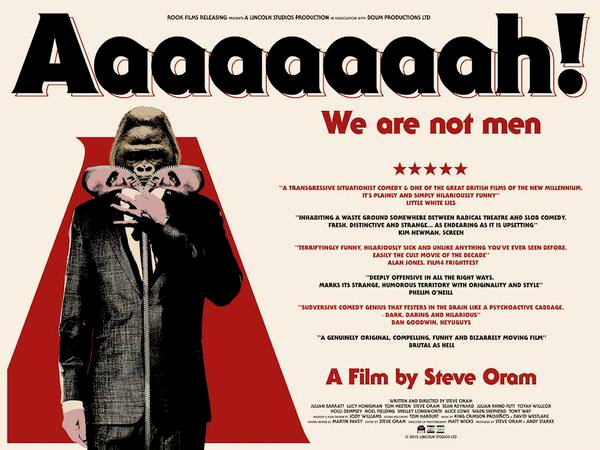
AAAAAAAAH! WE ARE NOT MEN // DIRECTOR INTERVIEW!


You might remember Steve Oram from his decade and a half of continuous character and background work in such worthy Britcom projects as Green WingThe Mighty BooshTittybangbang and Steve Coogan Live. Or perhaps you remember him as the bearded half of the comically bumbling yet oddly endearing serial killer couple in Ben Wheatley's magnificent 2012 satire, Sightseers.

However, it doesn't much matter how--or even if--you knew of him beforehand. Because there is nothing in Oram's pre-2015 catalog that could possibly prepare you for the certifiably insane masterpiece of hyper-subversive comic audacity that is Aaaaaaaah!, his ferocious and fearless directorial debut, which he also self-financed for reasons that will become apparent as you read on.

Described by Cine-Vue's Martyn Conterio as being an "anthropological social satire/horror-comedy" that is "like a collaboration between Dogme '95 and Chris Morris", Aaaaaaaah! is, at its core, a relatively straightforward exploration of interpersonal dynamics among a small group of friends, neighbors and acquaintances in a quiet, leafy section of South London. The surreal twist on this relatively mundane premise is that all the characters behave as though they've had their brains switched out with those of great apes.

Here is the trailer for Aaaaaaaah!


There is no dialogue in this film. Or, more precisely, there is no complex language, as the characters communicate via crude, pantomime gesticulations, as well as vocalizations consisting of grunts and huffs of varying intensity. The written version of this ape language, which can occasionally be spotted on street signs and in adverts, looks like this: "// oooo / oo /// o". Discussions, or what passes for them, are often interrupted by flashes of violence and cruelty, crude sexual propositions, and the occasional fart. The score, made up almost entirely of improvisational sonic tone poems by King Crimson and Robert Fripp, compliments the action absurdly well.

The plot involves a pair of males--an alpha (played by Oram) and his submissive sidekick (played by Tom Meeten)--who wander out of a woodsy suburban copse and into a household already beset by seething familial, romantic, and inter-generational conflicts, throwing the fragile established order into chaos. The household consists of a mother and daughter, (Lucy Honigman and Toyah Wilcox) and mom's alpha boyfriend (Julian Rhind-Tutt), who has a submissive sidekick of his own (Sean Reynard). Complicating matters is the family's fifth wheel, the exiled paterfamilias, beautifully portrayed by Britcom MVP Julian Barratt.

You might think such a heady set-up would lend itself to the filmmakers indulging in a bit of heavy-handed social commentary. Fortunately, you'd be wrong about that. In an interview with HeyUGuys.com, Oram states: "There are no metaphors and no intended comments. It’s just details that I hope people will enjoy, find funny and laugh at."

And oh, those details! Aaaaaaaah!'s hilarious gross-out highlights include a store manager ejaculating on a photograph of Prince Harry, a disgusting cooking show watched by the females while the men play a primitive motorcycle simulator video game, and poor Noel Fielding getting his knob bitten clean off by an angry shoplifter.

And yet, the filmmakers' avoidance of allegory notwithstanding, there's something about Oram's walk-through of his conquest's flat during a party, wherein he continually marks his territory by pissing on every surface, that manages to transcend the grotesque and speak to certain unspoken truths about masculinity and our culture's relationship with our baser animal instincts. Perhaps it's for this reason that, in his enthusiastic review for the "men's issues" column from The Telegraph UK, Tom Fordy claims that "every man should watch Aaaaaaaah!". Meanwhile, over at The Guardian, their shorter, 3-star review chose to focus on "the film’s despair at the ways women respond to such shows of mastery".

Ultimately, Aaaaaaaah! is an incredibly bizarre and transgressive experimental film that also works as a comic entertainment, simultaneously relate-able and recognizable yet disturbingly alien, and therefore worthy to sit alongside the best of Bunuel.

If you think you've got what it takes to watch Aaaaaaaah!, you can currently download it at the iTunes website via this direct link.

***

MINI-INTERVIEW WITH AAAAAAAAH! CREATOR STEVE ORAM
After reaching out to his management via Twitter, I was recently fortunate enough to get a chance to ask Mr. Oram a few questions about his film, which he graciously agreed to answer for me via email. Here, now, is the sum total of our online exchange.
JERKY: Can I get a rough estimate of the budget? And was it entirely self-financed, or at least entirely independently financed, as I've seen intimated (but never confirmed) in various media stories about the movie?

STEVE ORAM: Yes it was an entirely self-financed movie. Paid for with proceeds from a TV voiceover I did. It was entirely independent and so without any 'creative' input from outside. The actual budget - well think of the lowest budget feature film you've seen, it's about that.

JERKY: Was the addition of the sub-titular appendix "We Are Not Men" an after-thought for the North American market, to make it easier to find in search engines? And does it have (as I suspect) a Nietzschean meaning?

STEVE ORAM: I wish! The search engine thing is an absolute nightmare. On social media anyone searching for it will just come across a thousand people going aaaaaggh! about someone's haircut or something. I wouldn't say I aligned myself with Nietzche or any philosophy. It's just the idea that we aren't as special as we kid ourselves to be. We're no better than any of the other animals at the end of the day.

JERKY: That ending... WHY?!?!?

STEVE ORAM: Well I hope the ending feels true to human nature. Julian Barratt's character is totally disenfrachised and emasculated throughout the film and this has to have its catharsis. Quite often an audience will actually laugh at the ending which astonishes me. Maybe this is an awkward thing, I dunno. Or else there are a lot of sick people in my audiences.

CRIMSON PEAK / EX MACHINA / WE ARE STILL HERE


The real world mystery of CRIMSON PEAK's myriad failures is far more perplexing and disturbing to me than the fictional mystery at the heart of the film. Perhaps doubly so because I have long admired Guillermo del Toro both as a director and as an ambassador for high quality genre film-making. The man is one of the best "movie" directors working today, with many near-perfect popcorn flicks under his belt, and he's given the world at least one bona fide cinematic masterpiece in Pan's Labyrinth. So what the hell happened with Crimson Peak

First and foremost, it isn't very scary. The ghosts are essentially just souped up versions of the overly-CGI titular specter from the 2013 horror hit Mama, which was also produced by del Toro, and which also featured Jessica Chastain in a leading role. Of course, in interviews, del Toro claims that he never set out to make a horror movie, but a "Gothic" romance, in the formal sense of the word. But invoking a word was never going to keep this film's audience from feeling misled, especially after Crimson Peak's marketing campaign tried to position it as "the ultimate haunted house movie", complete with a Halloween-friendly release date and a ringing endorsement from Stephen freakin' King.

Adding more sting to Crimson Peak's failure is the fact that, despite the above-mentioned expectational handicap, it actually starts out pretty strong. In bringing the people and places of late 19th century Buffalo to life on the big screen, one authentic detail at a time, del Toro succeeds in conjuring up some legit movie magic. He gives his actors a very real, believable universe to inhabit, and they repay the favor by delivering organic, easy-to-root-for performances. Mia Wasikowska, Tom Hidleston and the aforementioned Chastain are more than adequate as the central, incestuous love triangle (Gothic indeed!), while Burn Gorman and Jim Beaver provide stand-out performances in supporting roles. 

So when and where does the whole enterprise go pear-shaped? I've got it pinned down to a single scene, which features one of the worst shaving "accidents" ever captured on screen. After that, when the setting jumps overseas to England's bleak and blustery North Country, it's almost as if del Toro lets everything drop so he can spend all his time concentrating on his most obvious priority: Crimson Peak, itself. He spends so much time exploring every nook and cranny of that isolated, dilapidated and, admittedly, gorgeously-rendered manor house that he hardly has time for such petty annoyances as characters, plot, or anything else. The film descends into a series of silly, predictable, occasionally bloody but ultimately uninvolving set pieces, and the whole thing ends with a decidedly muted whimper, almost as though del Toro and crew knew that they had a lemon in the can. 

It's fucking depressing, is what it is. 

Because I'm still a fan of del Toro's work, I feel compelled to point out that even though it was a box office failure, Crimson Peak does have its defenders. Unfortunately, to this fan's way of seeing things, it is an occasionally interesting, somewhat noble, but ultimately failed, experiment.


Late last year I started watching EX MACHINA, starring current Star Wars Universe newbies Oscar Isaac and Domhnall Gleeson as a reclusive billionaire genius inventor and his amanuensis/guinea pig, whom he flies out to a ridiculously opulent Alaskan compound to serve as a human Turing Test for his latest invention: Eva, a beautiful synthetic humanoid AI portrayed by Swedish ballerina Alicia Vikander. After about 15 minutes, I got the sense that this was a low-budget take on the "Singularitysploitation" film genre that has given us the moribund likes of Transcendence and Lucy, so I gave up on it. 

This week I finally got around to watching the whole thing, and I'm very glad that I gave it a second chance. Ex Machina is a strong film in pretty much all respects, and it works on many levels. It is, for instance, a great twist on the Frankenstein story. It also works as a high-tech corporate thriller of sorts, but that doesn't prevent first-time director Alex Garland from weighing in on some pretty heavy contemporary philosophical issues as well, even though his film isn't as subtle or explorative as, say, Spike Jonze's somewhat similarly-themed 2013 masterpiece, Her. 

Performance-wise, Oscar Isaac delivers the star turn here as Nathan Bateman, a preening, egotistical, hyper-dominant alpha whose behavior towards his employees (and creations) pivots from buddy-buddy to borderline psychopathic with disorienting speed. It is in these moments and others that Ex Machina veers into horror movie territory, a tonal shift accentuated by an impressive and very effective musical score. 

In this cinematic era of dumbed-down superhero sequels and endless retcon reboots, it is a rare thing indeed for a sci-fi movie to exhibit any kind of genuine intellectual curiosity, or demand a certain level of intellectual sophistication from its audience. That Ex Machina manages to do so while also being an unapologetic entertainment is, in and of itself, a great success. 

With projects like Ex MachinaHer, and the British TV series Black Mirror breaking bold new ground and expanding what is considered possible to portray in the realm of popular speculative fiction, perhaps the "Singularitysploitation Curse" has, at long last, been broken. One can only hope.


There seems to be a running theme in today's movies. Crimson Peak is about a massive, ancient, decaying English manor house that seems to have a life of its own. Ex Machina is set in a sprawling, isolated compound in the middle of the Alaskan wilderness; a cross between a penthouse apartment and the Overlook hotel. And in WE ARE STILL HERE, a grieving couple who have lost their adult son attempt to distract themselves by moving into a hundred-plus-year-old farmhouse that used to be the town funeral home, somewhere in rural New England. Smart move, folks!

The first full-length film to be directed by veteran indie horror writer/producer Ted Geoghegan, We Are Still Here is set in 1979, and was shot to seem as though it was made back then, too. This is a cinematic stunt that Geoghegan-associated director Ti West performed with great success for his 2009 retro-horror slow burn classic, House of the Devil. Genre MVP Barbara Crampton portrays grieving mom Anne Sacchetti, who believes her son Bobby's soul has followed them to their new home, and Andrew Sensenig plays her gently humoring but deeply skeptical husband, Paul (the man with the Biggest Forehead in the World). 

Things turn real creepy real fast, as photographs get knocked over, an electrician is brutalized by a half-seen evil presence, and a neighbor (Monte Markham!) stops by to divulge the awful history of the house and its 19th century tenants, the dreaded Dagmar clan. Seems old Lassander, the Dagmar paterfamilias, had taken to burying empty coffins in the graveyard, selling the townsfolk's deceased to nearby universities as practice cadavers, and also to certain unscrupulous restauranteurs in Boston's Chinatown, for use as Chop Suey eat. Needless to say, the whole family was ridden out of town on a rail.

After that, the weirdness escalates quickly, prompting Anne to call in her wacky, New Age friends, May and Jacob Lewis, played by Lisa Marie and Larry Fessenden (an indie horror institution and the man with the Second Biggest Forehead in the World), for moral and spiritual support. She also invites May and Jacob's son, Harry, who was Bobby's college roommate, to tag along with his girlfriend. Unfortunately, the mayhem escalates so quickly and with such brutal, bloody violence that many of the characters never even get a chance to lay eyes on each other. 

Nostalgic and yet somehow, paradoxically, fresh and original; polished and professional, yet with an endearingly hand-crafted aesthetic; occasionally chuckle-inducing, yet with moments of brutal savagery and blood-freezing horror. As I watched, enthralled, I noted echoes of classic John Carpenter, Lucio Fulci, early Cronenberg and the amazing, sui generis masterpiece Phantasm (1979). Fans of classic horror cinema, you owe it to yourselves to seek out and watch this film at your earliest possible convenience.

[This article was edited on the evening of Thursday, January 7, 2016, to correct certain mistakes as pointed out by my writing partner and best buddy, Marc Roussel. Thanks, Marc! - YOPJ]

BONE TOMAHAWK / AMERICAN MARY


BONE TOMOHAWK is a gift of a film; a master-class in stylistic blending that deftly combines the best of what frontier westerns and the cannibal horror genre have to offer. Despite a deliberate, careful pacing, momentum never lags as each passing moment is chock-a-block with wonderful, infinitely quotable dialogue and some truly fine performances by the uniformly superlative cast of veteran character actors.

Kurt Russell is at his best here as the dogged, stalwart Sheriff Franklin Hunt, of the tiny, isolated town of Bright Hope, which itself is populated by a collection of the usual suspects, including an ageing but resourceful deputy, a prideful, upper-class veteran of the Indian Wars, a timid barkeep, some hard-working, hard-drinking frontiersmen, their dutiful, inordinately attractive wives, and a colorful bad man or two. Sid Haig and David Arquette are particularly excellent in the opening scenes.

Fair warning: BONE TOMAHAWK starts off in a relatively conventional manner that gives precious little warning before erupting into a grim, horrific, gore-drenched struggle for survival. Featuring one of the most gruesome on-screen killings in recent memory, BONE TOMAHAWK is not for every taste. It is, however, destined to become a cherished and beloved cult classic for as long as people watch, and love, bold and innovative genre motion pictures.


As is often the case with films that cater to a particular element of contemporary fandom*, there are many cliches that apply to the Soska Sisters' aesthetically ambitious and ethically ambiguous sophomore effort, AMERICAN MARY.  Its reach exceeds its grasp, for one. However, if you have no problem suspending your disbelief for 90 minutes - and if you're either a member or curious observer of the "body modification" subculture - then perhaps this cinematic exercise in feminist revenge fantasy is just the thing to spice up your Sunday evening at home with the better half.

AMERICAN MARY tells the story of Mary Mason (portrayed by Katherine Isabelle), a promising and attractive young medical student from Seattle whose money woes force her to consider moonlighting as a stripper. After giving Billy (the bar's sleazy owner) the world's most unenthusiastic massage, a situation arises that leads to Mary being offered $5,000 cash if she can save the life of a double-crossing gangster, whom Billy's associates have been torturing in the basement. Mary's reluctant agreement to do this, and her success in the deed, are what lead to her subsequent decision to enter into the wonderful, whimsical, oh-so-90's-retro world of body modification.

For a movie that is a self-described reaction to the recent wave of cinematic "extremism" in both Europe (think MARTYRS) and Japan (think Takeshi Miike), I found AMERICAN MARY to be more silly than disturbing. A list of every character, line of dialogue, location, motivation, or decision made in this film that could fairly be described as "ridiculous" would stretch quite a long way, indeed. A few key examples should be enough to give you a general idea of what I'm referring to...

First and foremost, there's the film's oddly childish Riot-Grrrl-meets-torture-porn weltanschaung. You get the feeling that the Soska Sisters really believe that shit can go down the way they portray it going down in this movie, particularly at the 100% male-run "surgery school" that Mary attends... up until the moment when the professors all gather to assist the vilest among them - a character who's been twirling his mustache since we first laid eyes on him - to drug and rape Mary (and film it!) in order to ensure that the world of surgical practice remains an elitist, patriarchal cis-pit of unchecked male privilege... or something.

There are other, more basic believability issues here, too. Like, for instance, if her money troubles are so bad, why doesn't Mary just move out of that massive, cathedral-sized apartment of hers, and into a place more befitting her status as a student? And don't get me started on the idea of complex operations being performed successfully, solo, without any preparation whatsoever. Apparently, all it takes to make it big in the lucrative world of plastic surgery is a surgical mask, some gloves, a bag full of sharp blades, and raw surgical talent! No wonder the Old Boy's Club is trying to fortify that Glass Ceiling of theirs; if the truth ever got out about how easy their job is, it would totally derail their Gravy Train!

From the arguably objectionable to the merely annoying, we have Billy's weird, unrequited crush on Mary, which goes nowhere, story-wise. The character of Lance, one of Billy's hired thugs, is another annoyance; what is it with tough guys in Canadian movies all having long, greasy hair, wearing sunglasses, leather jackets and gloves, and secretly being soulful, supportive gentlemen? And then there's the Soskas' infamous Hitchcock moment, wherein they appear as the Demon Twins of Berlin, stereotypically "shocking", pseudo-incestuous Goth sisters who prattle away in ersatz German accents and wish to feel "more connected" by exchanging left arms with one another. Just like the detective who occasionally pops by to briefly question Mary about her instructor's mysterious disappearance, they come and go with neither consequence nor raison d'etre.

So... is AMERICAN MARY completely worthless? Not at all. At times it's enjoyable in an early Rob Zombie kind of way; like flipping through back issues of Fangoria Magazine while listening to Alice in Chains on an old CD Walkman. The practical effects are convincing, and the film looks pretty good, with a dark, rich color palate and some interesting shot compositions. There are also a couple of particularly enjoyable performances.

Katherine Isabelle has been Canada's best Scream Queen since her star-making turn in the excellent feminist werewolf movie GINGER SNAPS, and she does her best to make Mary into a believable, complex, and sympathetic character... no mean feat, considering some of the nasty business she gets up to. That Isabelle brings so much to the character that isn't, strictly speaking, "on the page" shouldn't come as a surprise, seeing as the Soskas wrote the screenplay with her in mind. The other notable performance in this film is Tristan Risk as the strange but compelling character of Beatress. Performing through an impressive latex approximation of Betty Boop, Risk conveys a paradoxically jaded innocence that stayed with me for days.

Of course, while good performances and decent cinematography can go a long way, they don't, in and of themselves, make for a successful film; especially one with the issues I've described. So, ultimately, I'd describe AMERICAN MARY as a failure... but an ambitious and intriguing one. And seeing as it's still early in the Soskas' film-making career, I will definitely continue to check out their work.

* AMERICAN MARY is literally dedicated to Eli Roth!